Posts

Showing posts with the label linguistic typology

Online resources on linguistic typology and beyond

Image
Many Humans Who Read Grammars are also teachers of some kind, myself included. With the world-wide outbreak of COVID-19, most of this teaching is forced to be no longer in a classroom setting, but rather in a remote fashion. This comes with one benefit: if someone can tell it better than you, and a video of it happens to be on youtube, get your students to watch that lecture! So, please find some resources on linguistic typology & co below. First up is a short list of youtube videos on linguistic typology and some related topics. There is an entire MA course called 'Language Typology' from the Virtual Linguistic Campus (Uni Marburg). Here is a link  to the  Virtual Linguistic Campus , featuring many more lecture series on topics in linguistics. The same for this course here , a full course from the NPTEL-NOC IITM channel that contains a lot of courses, also on linguistics. A  set of mini-lessons in linguistic typology by  Isabel Cooke McKay , including ...

A decade of state-of-the-art quantitative methods in linguistic typology

Image
Some turning points in linguistic typology are easily recognised, such as the ground-breaking work by Joseph Greenberg on implicational universals entitled "Some universals of grammar with particular reference to the order of meaningful elements" (Greenberg 1963). Other turning points are less well-defined, less commonly associated with a single paper, or a specific typologist, team, or place. But there was definitely something in the water during, let's say, a period  centred  around 2010  –  a change that we could call the quantitative turn in linguistic typology.  Linguistic typologists have long recognised that the languages of the world are related in various ways, most importantly, in nested arrays of hierarchical descent (genealogy) as well as in so-called Sprachbunds or linguistic areas (geography). For a long time, i.e. work reaching from Bell (1978) all the way to Bakker (2010), these interdependencies have been viewed as something of a nuisance, so...

Spurious correlations

Image
*apologies for pay-walled links ahead* I was first confronted by spurious correlations in language and culture during the EVOLANG 10 conference in Vienna in 2014, where I think I saw a poster on the relationship between tense marking and economic behaviour. If I remember correctly, this poster build on the famous findings of Keith Chen, who published a paper in 2013 on the relationship between obligatory future tense marking and various types of social and economical decisions people take. The paper was very controversial before it was even published, with posts on Language Log (see links at bottom of the page for more posts)  a reply on Language Log by Keith Chen  and a variety of media coverage that can be found here and here and here  and here . Chen found that languages lacking a distinct future tense: "save more, retire with more wealth, smoke less, practice safer sex, and are less obese" (abstract). He explains his findings as follows "[...] being require...

Diachronic and functional explanations of typological universals @ SLE2016

Image
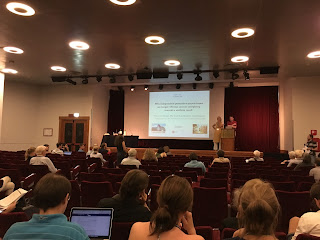
The last two days I attended the workshop "Diachronic and functional explanations of typological universals" at the 49th Annual Meeting of the Societas Linguistica Europaea in Napels, Italy. This theme session was organized by Natalia Levshina, Ilja Serzant, Susanne Michaelis and Karsten Schmidtke-Bode, the description can be found here (page 409-410) and the introduction can be found here . The purpose of the workshop was to draw attention to the importance of diachronic explanations for typological universals. Typological universals were also the topic of Jeremy's last post . They are properties found in (nearly) all languages, or if not all, enough languages to deserve an explanation. Jeremy discusses word order universals, an example being that if a language has verb-object word order, it is also likely to have prepositions, i.e. to have adposition-noun order (see Matthew Dryer's map in the World Atlas of Language Structures Online ). Many explanations prop...

Workshop in Jena on Austronesian linguistics, archeology and genetics

Image
Last week at the new MPI for the Science of Human History in Jena, there was a two-day workshop on the peopling of island Southeast Asia and the Pacific, organised by Russell Gray, Lisa Matisoo-Smith and Simon Greenhill.  It was divided between talks on archeology, linguistics and genetics, with a couple of others on computational modeling from anthropology and ecology.  The titles and abstracts of talks are  here .  Here is my brief and perhaps slightly garbled summary of the talks. Archeology Bob Blust said in his talk that linguistics can make predictions for archeology, such as the presence of Neolithic rice remains in Taiwan, because Austronesian languages originated in Taiwan, and Proto-Austronesian is reconstructed as having many terms for rice.  This prediction turned out to be vindicated, such as by japonica rice grains found at the 4500-5000 BP site at Dabenkeng.  In this spirit, some archeology talks were on migrations which we kn...

That infographic on languages of the world - some context to help you understand what's going on

Image
Have you seen this infographic ( click here for original post and larger size )? It's been floating around various linguistics blogs, been shared of 32 thousands times on the book of faces and been reblogged and retweeted in many other places.  I bet you found a flaw in it! Did you read the fine print and look up the sources (it's mostly from just this page )? No? It's ok. Allow me to give some explanation and context, as a diversity linguists working with public outreach - I'd like to take this chance to explain some things about data on languages of the world. © 2015 Alberto Lucas López, South China Morning Post  Publishers Ltd The international edition of the newspaper South China Morning Post (SCMP)  published this infographic of languages of the world  on the 27th of May and later updated it. SCMP is an English language newspaper based in Hong Kong. They have a great internet presence and have made several neat infographics  on other topics....