Posts

Showing posts with the label language maps

Language family maps
Image
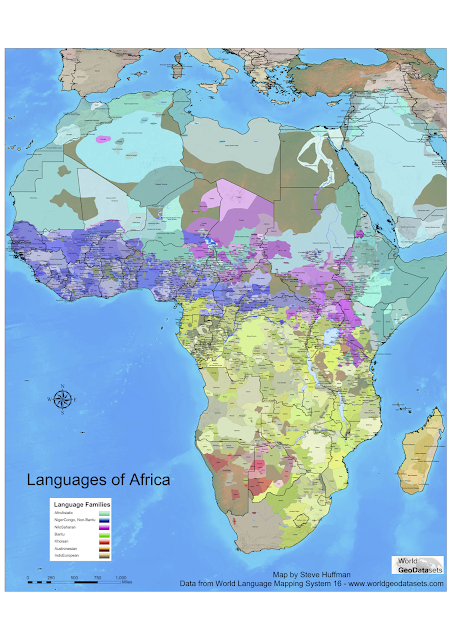
Last week, I assigned Bernhard Comrie's (2017) chapter 'The Languages of the World' (from The Handbook of Linguistics, 2017) to a class. It's a basic overview of the world's language families, which is what I wanted them to read, but for one thing: there are no maps in it. I overcompensated in class by presenting a 30-item list of maps, because some things are just so much easier to understand using visual representations. I decided to post some of the best ones I could find here, for future reference and in order to invite you to post better ones in the comments. This blog has featured posts on maps before, by  Hedvig on how to best represent linguistic diversity on maps and by  Matt on new approaches to ethnographies-linguistic maps . It's clear that the kind of maps that are typically used to depict the spatial distribution of languages of a single language family are fraught with difficulties. Typically they deal with multilingualism very poorly, the data...

That infographic, again ;)

Image
In 2015 I wrote a blogpost about Alberto Lucas López visualisations of the worlds languages.  I answered some frequently asked questions in relation to that visualisation, mostly to do with Ethnologue's definitions of languages, macro-languages and speakers. There's a lot more context needed to fully understand that infographic, and every time I see if re-shared I see the same questions pop up. It's a good infographic, so I understand that it goes viral - but when the same questions come every time it means that more context is needed.  Since then, Alberto (who is now Senior Graphics Editor at the National Geographic) has released an updated version, which among other things fixes the color of Mexico.  I haven't gone through to check what else has been adjusted, but many of the same questions will remain. This is because Ethnologue's classification of what is and what is not a language (which still underlies the visualisation) is still controversial at times a...

Linguistic map making: Drawing polygons

Image
Hedvig has written o n how Ethnologue has become even more restricted than it already was , and what resources are out there that could be used instead. One of the things I miss from Ethnologue are its maps - although at least recently it was still possible to access most of these, by downloading them instead of viewing them on your browser. In her post, Hedvig points out that Langscape can be used instead, and that's all great. But what if you wanted to draw a map yourself? Especially one which you intend to publish? Some institutions may have access to the World Language Mapping System  (WLMS), which lies at the core of Ethnologue's (and Langscape's) maps, and was made by Global Mapping International ( which recently was closed, and now the WLMS is back formally with SIL ). I'm not sure about the details (and the user agreement parts of the WLMS website are down), but paying a lot of money for the WLMS must enable users to draw their own maps and publish them, as ...

Speakers per language diagram & International Linguistics Olympiad memes

Image
Hello readers of Humans Who Read Grammars, As well as writing on this blog, I also work with the International Linguistics Olympiad (IOL*). The IOL is a contest for students of secondary school from all over the world where they get to compete in solving linguistic puzzles. Normally in order to explain what the contest is all about I send people to the page with old problem sets,  but there's a hip IOL-meme page that's produced some very apt memes that may do a better job at explaining the contest to linguists. I'll paste them in below. ( Remember how we started as a meme-based blog for typologists? ) I recently made a post on our blog over there about the dominance of European countries in the contest and language diversity . For that post, I derived a little data visualisation of speaker populations per language (based on the 19th edition of Ethnologue) with infogram . I thought y'all might like it as well, so I'm sharing it here too. By the way, if you...

New Approaches to Ethno-Linguistic Maps

Image
I’m excited to give a guest blog post here at humans who read grammars on new methods in language geography.  I’m a geographer by trade, and I am currently a PhD student at the University of Maryland.  I also work for an environmental nonprofit - Conservation International - doing data science on agriculture and environmental change in East Africa.  Before ending up where I am now, I lived for some time in West Africa and the Philippines.  During my time in both of those linguistically-rich areas, I became quite interested in language geographies and linguistics more generally.  Spurned on by curiosity and my disappointment in available resources, I’ve done some side projects mapping languages and language groups, which I’ll talk about here. Problems with Current Language Maps A map of tonal languages from WALS.  Fascinating at a global scale, but unsatisfying if you zoom in to smaller regions. One major issue with most modern maps of languages is...