Posts

Showing posts with the label meme

Speakers per language diagram & International Linguistics Olympiad memes

Image
Hello readers of Humans Who Read Grammars, As well as writing on this blog, I also work with the International Linguistics Olympiad (IOL*). The IOL is a contest for students of secondary school from all over the world where they get to compete in solving linguistic puzzles. Normally in order to explain what the contest is all about I send people to the page with old problem sets,  but there's a hip IOL-meme page that's produced some very apt memes that may do a better job at explaining the contest to linguists. I'll paste them in below. ( Remember how we started as a meme-based blog for typologists? ) I recently made a post on our blog over there about the dominance of European countries in the contest and language diversity . For that post, I derived a little data visualisation of speaker populations per language (based on the 19th edition of Ethnologue) with infogram . I thought y'all might like it as well, so I'm sharing it here too. By the way, if you...

Best Linguist Meme Ever (if I may say so myself)

Image
I must admit, I'm inappropriately satisfied with this meme from the previous post so I'l repost it again in its own post so it can be spread more easily.

When I have to deal with irrealis

Image
Irrealis is a grammatical term that covers a range of functions that are in the non-realised, imagined sphere of events, states and actions, such as future, negation, subjunctive, optative etc. It's most often described as a mood or modality, but not always. (This is related to whether future is a tense or a mood.) Typically, if the marker in question only marks future it is not called "irrealis" but "future" or "non-past" if applicable, but it might be called "irrealis" because neighbouring languages use a cognate to encode other irrealisy functions and such is the convention in that descriptive tradition (which does make sense). And of course, irrealis, future and related functions tend to grammaticalise into each other over time, and create nice fuzzy stages that we linguists can tear our hair out over (finally admitting to ourselves that while we love natural languages, they also drive us crazy). Basically, there is a lot of di...

When people talk about turn taking

Image
It's been such seriousness here lately, it's time for some scientifically motivated gifs! Whenever people talk about turn taking (the switching of who's speaking in a conversation) and in particular the acquisition of this skill, I can't help but think of the talking twin babies of the you tubes . They are an excellent example of the fact that turn-taking is something that we as beginner humans do and practice on before learning "words". Go watch the video  and you'll see what I mean, those are some highly competent conversational partners. Or just try and make a sound or a sign to a baby and watch it evaluated the turns in the conversation and preform very well. How does turn-taking relate to diversity and description you might ask? Well, we know far to little about the acquisition of non WEIRD-languages  and this is a very, very important part of understanding language, both at the specific level and the comparative. Do languages have co...

WEIRD and LOL-languages

We've heard before about WEIRD languages and communities, i.e W estern E ducated I ndustrialised R ich and D emocratic. The point of that label is to highlight the fact that much of the research that has been done in the study of human culture (psychology, linguistics, anthropology, sociology etc) is only representative for a small subset of all humans that live on this planet of ours. Most notably there is currently the " Making Science Less WEIRD"-initiative , you can read more about that and other related items  here . Now, prof. emeritus Östen Dahl has come up with a new useful abbreviation: LOL. It stands for L iterate, O ffcial and with L ots of users. I learned this from reading the abstracts of the last linguistics conference at the dept of linguistics at MPI-EVA . Here is an excerpt from that abstract that explains the motivation behind this term: I think, however, that we may also be led a bit astray by the catchy acronym WEIRD in that the adjectives it en...

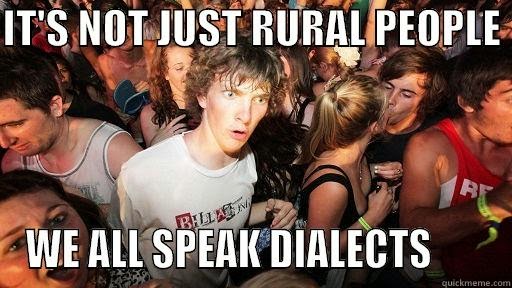
WE ALL SPEAK DIALECTS

Image
In relation to the recent post on "a language is a dialect with an navy and an army/missionary and a dictionary ", I thought this meme needed to come into existence. Now, here it is! Hurray! A dialect is a sub-variety of a language, often defined by geographical borders, but not necessarily. We all speak dialects, most often more than two. No-one speaks "just a language", or at least I have a very hard time understanding what that would even mean. Perhaps if one was the only ever known speaker of one language.. Feel free to talk to us about that down in the comments or  here  ^^! We mainly talk about dialects when referring to less standard varieties, most often rural areas or informal language. But, they're all dialects. The language of the capital, of the television and of the written press are also dialect(s). We all speak dialects.  Just as with other kinds of norms it's hard to realise that they exist at all if one is part of the most ...

When You Meet Some Natural Science/Engineer Person Who Says That Linguistics Seems Easy

Image
Also applicable to when you yourself set up a research plan and devoted too little time to the phase labeled "data collection".

How Not To Do Linguistic Fieldwork

Image
This is actually an old post by Suzanne back on tumblr , but since we've invited some more fieldworkers to join us here on blogger I figured this deserved a re-post :)!

Academic humour from the Swedish West Coast!

Image
I've got something for those of us who enjoy satirical linguistics (looking at you  speculativegrammarian ) and/or jokes based on adventures and anxiety during grad school (looking at you  whatshouldwecalllinguistics  &  @researchinprogress ). Two comedy gems from the Gothenburg! First, we've got "Conversation as Paranoia" by Hugh Aelgh from 1976 ( free original PDF here  and  digital specgram-version here) . There we can learn the 11 principles of paranoia. It starts with: This paper has arisen as a direct reaction to Allwood 1976. In his thesis, Allwood tries to show that human beings are rational and cooperative and that this is particularly true of them when they talk. This, of course, is utter nonsense. Such an absurd view can only be the result of the author’s complete neglect of all serious research in the study of human behavior, such as the work of S. Potter and C.N. Parkinson. I now want to show that human communication behavior ...
Image
These are linguistic trading cards that were made by  Mikael Parkvall,  there's a whole great collection of them. I'll put up some more under the tag "lingvistiska samlarbilder" ("linguistic trading cards"). They are in Swedish, but I think you don't need no Google translate to figure out "citat av X". I'll put up the ones that will be understandable to you (I'll leave the Swede-internal jokes ^^)! These two features Noam Chomsky and  Nim Chimpsky . Nim was one of many chimpanzees that we have tried to teach some kind of language similar to humans. You can read more about him, the studies and controversies  here . The name is, as you might have guessed, a pun on the name of the famous linguist Noam Chomsky who has, among other things, claimed that there are features of human language that other primates cannot acquire. In particular we are talking about the doubly articulated nature of the language system, i.e. ...

Humans Who Read Grammars on blogger too!

Image
We're on blogger now, too! We've been at tumblr now for a while, as Humans Who Read Grammars (popularly misunderstood as "Humans Whore Ad Grammars", what ever that means ^^). Now we're going to move posting of originals to blogger , under the same name. Posts here will still get to our tumblr and twitter. This is not a huge change, don't worry. It'll mainly make it easier for non-tumblrers to participate in discussions, and we get more formatting options. If you're on the blogger site and what to read older post by us: go to the tumblr. In particular, check out the tag Free Online Linguistic Databases and Goodie From Grammar Reading .   We'll continue writing posts about topics relating to linguistic diversity, documentation and description! Hurray! 

OH NO! END OF BLOG?!

Image
HOLD ON, NOT TRUE!  THERE'S LOTS MORE OLD POSTS ON TUMBLR FROM BEFORE WE MOVED TO BLOGGER.   YOU FIND 'EM HERE:  humanswhoreadgrammarsbeforeblogger In particular, we recommend checking out the tag  Free  Online Linguistic Databases  and  Goodie From Grammar Reading .  Have fun!