Posts

Showing posts with the label conferences

ALT2019 conference report

Image
Two weeks ago, the 13th Conference of the Association for Linguistic Typology (ALT) took place in Pavia, Italy. As the name says, this is the main gathering for members of the Association for Linguistic Typology , and it's on a different continent every two years. It just happened to be in Europe as I was ready to go conferencing again (now dragging two kids in tow) so that was lucky. I like ALT a lot because I can go to basically any talk and find myself interested in it. There are hardly any talks or posters where I am disappointed because it isn't really my cup of tea - it's all typology so everything is my cup of tea :)! It is where the humans who read grammars gather. This year, ALT was paired with a summer school on 'Language universals and language diversity in an evolutionary perspective', which I would have loved to attend (but, kids). For the first time in history (as far as we could find), ALT offered child care. About 5 attendees made use of this (...
Diachronic and functional explanations of typological universals @ SLE2016

Image
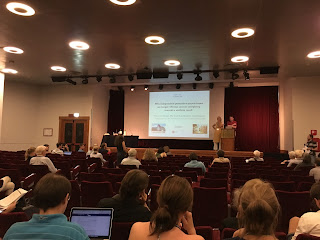
The last two days I attended the workshop "Diachronic and functional explanations of typological universals" at the 49th Annual Meeting of the Societas Linguistica Europaea in Napels, Italy. This theme session was organized by Natalia Levshina, Ilja Serzant, Susanne Michaelis and Karsten Schmidtke-Bode, the description can be found here (page 409-410) and the introduction can be found here . The purpose of the workshop was to draw attention to the importance of diachronic explanations for typological universals. Typological universals were also the topic of Jeremy's last post . They are properties found in (nearly) all languages, or if not all, enough languages to deserve an explanation. Jeremy discusses word order universals, an example being that if a language has verb-object word order, it is also likely to have prepositions, i.e. to have adposition-noun order (see Matthew Dryer's map in the World Atlas of Language Structures Online ). Many explanations prop...

Some language universals are historical accidents

Image
There are surprisingly few properties that all languages share.   Pretty much every attempt at articulating a genuine language universal tends to have at least one exception, as documented in Evans and Levinson's article 'The Myth of Language Universals' .   However, there are non-trivial properties that are found in if not literally all languages, enough of them and across multiple language families and independent areas of the world, that they demand an explanation.   An example is the fact that languages have predictable word orders.  Languages differ in whether they allow the verb to come before or after the object (English has it before, Japanese after).  They also differ in whether they have pre-positions (such as English ‘ on the table’) or post-positions (such as Japanese テーブルの上に teburu no ue ni ‘ ’the table on’).  If a language has the verb before the object then it tends to have prepositions rather than postpositions, as in English; if the...

Workshop in Jena on Austronesian linguistics, archeology and genetics

Image
Last week at the new MPI for the Science of Human History in Jena, there was a two-day workshop on the peopling of island Southeast Asia and the Pacific, organised by Russell Gray, Lisa Matisoo-Smith and Simon Greenhill.  It was divided between talks on archeology, linguistics and genetics, with a couple of others on computational modeling from anthropology and ecology.  The titles and abstracts of talks are  here .  Here is my brief and perhaps slightly garbled summary of the talks. Archeology Bob Blust said in his talk that linguistics can make predictions for archeology, such as the presence of Neolithic rice remains in Taiwan, because Austronesian languages originated in Taiwan, and Proto-Austronesian is reconstructed as having many terms for rice.  This prediction turned out to be vindicated, such as by japonica rice grains found at the 4500-5000 BP site at Dabenkeng.  In this spirit, some archeology talks were on migrations which we kn...

The Closing Conference of the MPIEVA Linguistics Department - Diversity Linguistics: Retrospects and Prospects

Image
This week was the closing conference of the linguistics department of the Max Planck Institute for Evolutionary Anthropology in Leipzig - Diversity Linguistics: Retrospects and Prospects. (Written about before with much excitement by Hedvig  here and here .) The talks were wonderful, presenting results of work done over many years.   This is a partial and idiosyncratic summary of my experience there, which has to leave out talks that I couldn't get to due to schedule clashes in the program.  They are listed here roughly by chronology, or by theme.  You can see the list of all talks and access their abstracts here.   A set of photos of the conference is here . Bernard Comrie summarized the achievements of the department over the past seventeen years, probably the main one being the World Atlas of Language Structures first proposed and built by Martin Haspelmath and David Gil.   This database set the precedent for linguistic databases tha...