Language family maps
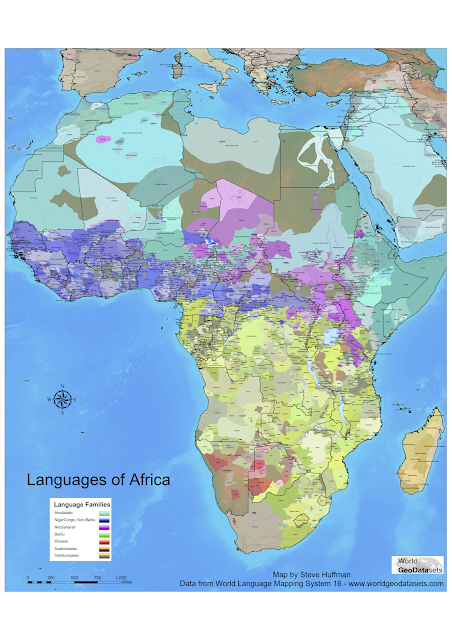
Last week, I assigned Bernhard Comrie's (2017) chapter 'The Languages of the World' (from The Handbook of Linguistics, 2017) to a class. It's a basic overview of the world's language families, which is what I wanted them to read, but for one thing: there are no maps in it. I overcompensated in class by presenting a 30-item list of maps, because some things are just so much easier to understand using visual representations. I decided to post some of the best ones I could find here, for future reference and in order to invite you to post better ones in the comments. This blog has featured posts on maps before, by Hedvig on how to best represent linguistic diversity on maps and by Matt on new approaches to ethnographies-linguistic maps . It's clear that the kind of maps that are typically used to depict the spatial distribution of languages of a single language family are fraught with difficulties. Typically they deal with multilingualism very poorly, the data...
