Posts

Showing posts with the label language

Online resources on linguistic typology and beyond

Image
Many Humans Who Read Grammars are also teachers of some kind, myself included. With the world-wide outbreak of COVID-19, most of this teaching is forced to be no longer in a classroom setting, but rather in a remote fashion. This comes with one benefit: if someone can tell it better than you, and a video of it happens to be on youtube, get your students to watch that lecture! So, please find some resources on linguistic typology & co below. First up is a short list of youtube videos on linguistic typology and some related topics. There is an entire MA course called 'Language Typology' from the Virtual Linguistic Campus (Uni Marburg). Here is a link  to the  Virtual Linguistic Campus , featuring many more lecture series on topics in linguistics. The same for this course here , a full course from the NPTEL-NOC IITM channel that contains a lot of courses, also on linguistics. A  set of mini-lessons in linguistic typology by  Isabel Cooke McKay , including ...

A decade of state-of-the-art quantitative methods in linguistic typology

Image
Some turning points in linguistic typology are easily recognised, such as the ground-breaking work by Joseph Greenberg on implicational universals entitled "Some universals of grammar with particular reference to the order of meaningful elements" (Greenberg 1963). Other turning points are less well-defined, less commonly associated with a single paper, or a specific typologist, team, or place. But there was definitely something in the water during, let's say, a period  centred  around 2010  –  a change that we could call the quantitative turn in linguistic typology.  Linguistic typologists have long recognised that the languages of the world are related in various ways, most importantly, in nested arrays of hierarchical descent (genealogy) as well as in so-called Sprachbunds or linguistic areas (geography). For a long time, i.e. work reaching from Bell (1978) all the way to Bakker (2010), these interdependencies have been viewed as something of a nuisance, so...

International Women's Day - Joan Bresnan

Image
Today is International Women's Day. Here at HWRG we're celebrating it by highlighting an important female linguist. Today we're honouring Joan Bresnan, who together with Ronald Kaplan, founded the theoretical formal grammatical framework Lexical Functional Grammar (LFG) and has written numerous influential papers. Trading card of Bresnan by Parkvall . She is still active as a Professor Emerita in Humanities at Stanford University and also a Senior Researcher ( Spoken Syntax Lab ) at Stanford's  Center for the Study of Language and Information.  Her research and LFG is much informed by a wide knowledge of linguistic diversity, in particular of Australian and Bantu languages. LFG is still a popular framework in linguistics and continues to develop.  Here is a quote by Bresnan that illustrates her ideas and experience of formal linguistics very well: I began to realize that we theoretical linguists had no privileged way of distinguishing the possible formal...

Go play some language games!

Image
There are more and more exciting new tools cropping up for scientist to gather data, and in linguistics one new tool such is gaming! We just had a talk here at CoEDL at ANU from a researcher working on mutual intelligibility of closely related european languages - Charlotte Gooskens  - where they've been using games to investigate this question. Apropos that, I thought I'd let you all know about some games you can play that can further our understanding of language! Go play games, for science! Mutual understanding between closely related languages-game As a speaker of a major european language, how good are you at understanding your neighbours? Really... :)? Link to game. Link to science behind (don't look before playing!) LingQuest! How good are you at correctly identifying which language you're hearing? Test yourself on over 30 European languages and other languages from all over the world. Included are many languages currently under study in the DOBES-...

Generative and non-generative ideas of the current questions and aims of linguistics

Image
This is a blogpost about the way that different linguists see the great challenges and aims of linguistics, it's full of quotes that I hope will prove illustrative. The quotes are taken mainly from here   and here , you can also go there to read more. As usual, you're more than free to skim and scroll, there's quite a few quotes this time. On this blog we're interested in discussing  what the "Big Research Questions" in linguistics  are, and also we've been interested in getting past the functional-fenerative divide that often is very destructive.  Two of our readers even commented that the inflammatory "debates" of the Great War are "profoundly unattractive" and that they had left that part of linguistics intentionally because of it's unproductive nature. Here's Haspelmath describing the situation: It is not hard to see that linguists who work on linguistic diversity tend to fa ll into two very rough sociological g...

Smelling underarms in Apali

Image
We've had a new submission for Goodies from Grammar Reading - a series of blog posts with interesting, fun or in other ways noteworthy utterances found while reading linguistic description ( blogger posts here , old posts on tumblr here ). This one was noted by Siva Kalyan during Don Daniels' talk at the annual meeting of the Australian Linguistic Society (ALS 2015 in Western Sydney University). The example is taken from a collection of texts in Apalɨ by Martha Wade (Wade n.d.) and serves to illustrate the way this language encodes imperatives. The codes for this language are:  ena and  apal1256 . Original text : Vac-ɨna huji hisi sɨmɨl-ɨlɨŋ  u-avɨ-la-lɨ. Glossing : move.aside- 2sg.ds  underarm rotten smell- 1sg.imp  say- pl-hab-3 Translation: ‘ “Move aside and let me smell your underarm,” they say.’                  As utterances out of context goes, this...

Best Linguist Meme Ever (if I may say so myself)

Image
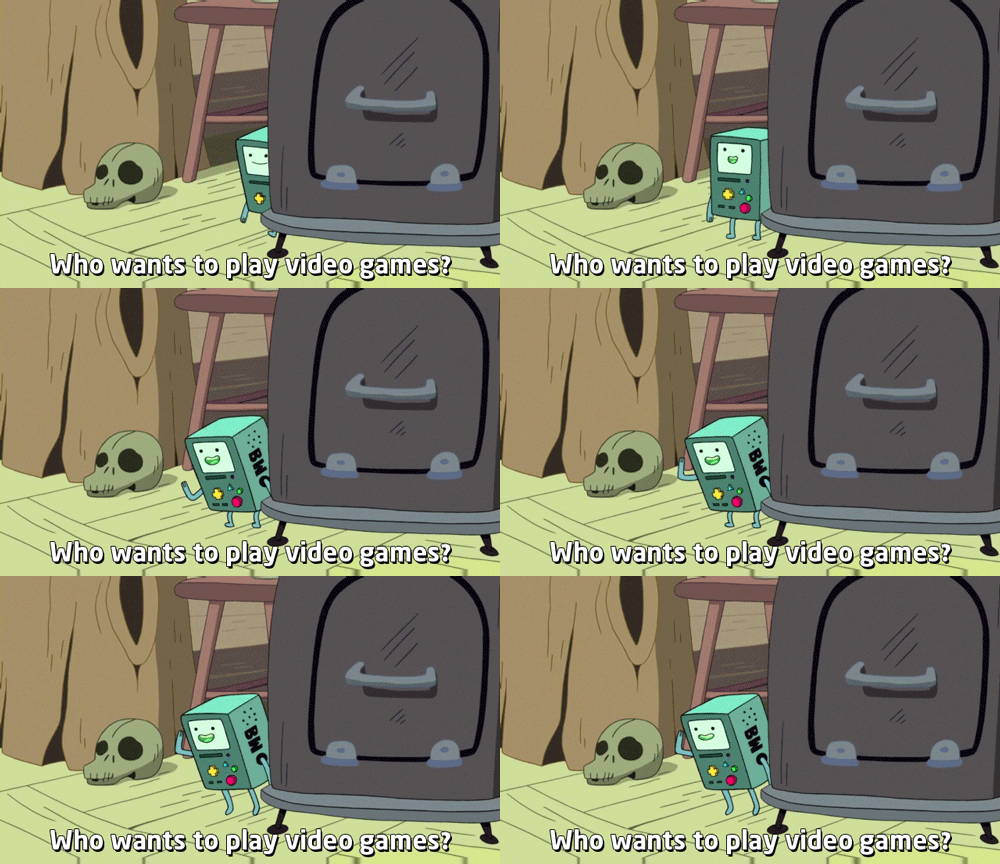
I must admit, I'm inappropriately satisfied with this meme from the previous post so I'l repost it again in its own post so it can be spread more easily.

When I have to deal with irrealis

Image
Irrealis is a grammatical term that covers a range of functions that are in the non-realised, imagined sphere of events, states and actions, such as future, negation, subjunctive, optative etc. It's most often described as a mood or modality, but not always. (This is related to whether future is a tense or a mood.) Typically, if the marker in question only marks future it is not called "irrealis" but "future" or "non-past" if applicable, but it might be called "irrealis" because neighbouring languages use a cognate to encode other irrealisy functions and such is the convention in that descriptive tradition (which does make sense). And of course, irrealis, future and related functions tend to grammaticalise into each other over time, and create nice fuzzy stages that we linguists can tear our hair out over (finally admitting to ourselves that while we love natural languages, they also drive us crazy). Basically, there is a lot of di...

USA census of languages only has 382 language categories

Image
I like digging around in censuses, especially of language use. I was just poking through the one from the US of A. I've just learned that in their census they collapse all the languages of the world into 382 categories. I thought this was rather interesting and that maybe you would be interested too. In the census of citizens and residents of the USA they basically ask: Do you speak a language other than English at home? Which? How well do you speak English? I'm guessing the 382 language categories is due to practical purposes, it seems that interviewers mostly have been using and probably still are using pen and paper.  I tried to figure out if it still is the case and will be for 2020, but I couldn't find that information on census.gov.  I could find out that you can answer by mail, phone or interview, probably meaning that it's all still on paper. Collapsing the 7,000 plus languages of the world into 382 categories makes sense if you have limited resou...