Posts

Showing posts with the label languages of the world

Language family maps
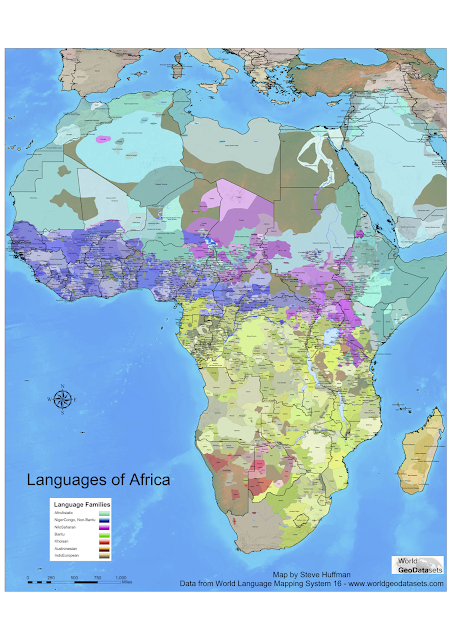
Image
Last week, I assigned Bernhard Comrie's (2017) chapter 'The Languages of the World' (from The Handbook of Linguistics, 2017) to a class. It's a basic overview of the world's language families, which is what I wanted them to read, but for one thing: there are no maps in it. I overcompensated in class by presenting a 30-item list of maps, because some things are just so much easier to understand using visual representations. I decided to post some of the best ones I could find here, for future reference and in order to invite you to post better ones in the comments. This blog has featured posts on maps before, by  Hedvig on how to best represent linguistic diversity on maps and by  Matt on new approaches to ethnographies-linguistic maps . It's clear that the kind of maps that are typically used to depict the spatial distribution of languages of a single language family are fraught with difficulties. Typically they deal with multilingualism very poorly, the data...

World map of language families from Glottolog

Image
World map from Glottolog, each language is one dot and coloured by language family (or other top-genetic unit). Language families are the main way we categorise and understand the language diversity of the world. A language family is a group of languages that have been analysed as having one ancestor,  one great-great-great-and-yet-greater-grand-mother language. Indo-European is a language family, with the sub-groups of Romance, Germanic, Slavic etc. Maps are great tools for visualising information,  we're pretty map-nerdy on this blog.   Robert Forkel, one of the editors of Glottolog, kindly shared an interactive map of the world with languages plotted out and coloured by language family with me. This map is interactive, rendered in a web browser with and html and json file. This map is not available on the Glottolog site, but will later be implemented in the command-line interface.  You can see language families on the website by either selecting a co...

Why are some languages often confused for others? FAQ wanted

Image
Seán Roberts, Lars Yencken and I have just published a paper on confusion of languages with data from The Great Language Game.  Alongside, we also created a new game:  LingQuest ! The Great Language Game is quite simple, players hear a short audio clip of people speaking and then they have to guess what language it is that they heard from some given alternatives. Very often people guess correctly, in our study we found that 70% of the time people guess correctly. But, what about those other times? What's happening there? What languages are players confusing for which? In this paper, we explore this question and test some different ideas for what it may be that is going on. The paper is getting some media coverage, and I thought we'd answer some Frequently Asked Questions (FAQ). So, please post your questions to us and we'll answer them! Cheese pic of me listening to sounds with a Great Language Game-t-shirt that Lars sent me One thing that I'm really happy ab...

Half of the world's languages are not Indo-European (but almost half of the population speak an Indo-European language)

Image
Big Think recently published an article titled "Half of All Languages Come from One Root Language. How it Spread Is Something of Debate" by Philip Perry .  This is a nice article that provides an introduction to the stormy debate on the origins of the Indo-European languages family to the public. It is always appreciated to see current research debate covered in popular press! T he article informs the reader that "half of the languages spoken today by some 3 billion people come from a single root language".  This is unfortunately  misleading, I'll provide some context here.  TL;DR Only 6% of the 7,000-ish languages alive today are Indo-European. However, 46% of people speak an Indo-European language. Languages are not evenly distributed across the population, i.e. not half of the world's languages are Indo-European even if almost half of people speak it. The writer is referring  to the Indo-European language family, the most studied and well-k...