Posts

Showing posts with the label grammarreading

A week of Bantu grammar reading: The good, the bad, and the ugly

Image
In my week of grammar reading, there were some truly good, truly bad, and truly ugly aspects. It was entirely devoted to Bantu , as it has been for some time, because of a project on Bantu gender systems I am doing together with Francesca Di Garbo of Stockholm University. Bantu languages are best known for their complex morphology, both involving the noun ( gender ) and the verb (Tense-Mood-Aspect). The noun typically is classified in up to around 12 different genders, signified by prefixes that attach to the noun root, and prefixes that mark agreement with the noun throughout the clause. To start with the good, below is an overview of nominal prefixes in Ding (diz), spoken in the Democratic Republic of Congo. The Roman numerals in the first column signify each gender, the two subsequent columns relate the singular and plural prefixes used for nouns, including different forms, and the final column gives examples of the type of noun found in each gender.  Merten...

Progress

Image
Sometimes it is just really nice to remember that there is progress in the description of (some) languages, even though it might take decades. From Lindblom, Gerhard. (1926) Notes on Kamba Grammar (Archives d’Études Orientales 10). Uppsala: Appelbergs Boktryckeri, page 34: "It was thought, for a long time, that East-African dialects did not have any musical accent, any fixed melody bound to the word as such, as in Swedish, Lituanian, Chinese and other languages. The researches of Meinhof and others have proved the existence of a musical accent in Kishambala and Kinyamwezi. I cannot fully ascertain, whether such an accent exists in Kikamba, but it is certain that there are in the language several words absolutely identical as to the constituent sounds, which in pronunciation are strictly distinguished by the natives. They have often laughed, when I have said the word for 'rust' instead of that for 'guinea-fowl' (see ex. below). As far as I can hear, there is no ...

Toasts in a grammar

Image
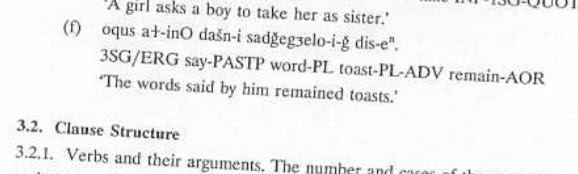
I'm reading Holisky & Gagua (1994), a grammar sketch of Batsbi. I just came across this sentence, "the words said by him remained toast". I like it, a lot. I take it that despite some sort of condition or expectation, the words he said remained to best be described as speeches or hot white bread. Like some sort of uncle at a wedding who never stops talking once he's got the space. There is no more context, so all we can do is speculate. Batsbi [bbl, bats1242] is spoken at the dot on this map below and transitivising affixes, inclusive pronouns and aorist. References Holisky, Dee Ann and Rusudan Gagua. 1994. Tsova-Tush (Batsbi). In Rieks Smeets (ed.), North East Caucasian Languages Part 2, 147-212. Delmar, New York: Caravan Books.

Glossing, how I miss you!

Image
I'm currently reading some older grammars that are written in a quite different style from most modern grammars. They're very ambitious, meticulous and good in many ways, but most crucial is the fact that they lack glossing. I miss glossing so! Glossing is a way for linguists to divide up utterances and translate more fine-grained units so that other linguists can have a better understanding of what's going on. When reading a grammar and trying to understand how the language works, glossing is immensely useful and practical. You as a reader might be interested in different things from the author, and glossing makes their analysis more transparent and makes more information available to the reader.  You can read more about it, and conventions for it, here. Let's make ourselves happier by looking at some of my favourite glossing ever, the texts of the project on Typology of Negation in the Ob-Ugric and Samoyedic language s. I'm not even kidding, looking at the...