Posts

Showing posts with the label goodiefromgrammars

International Women's Day 2017

Image
Last year, Hedvig wrote a post about the extremely prolific Joan Bresnan, co-founder of the formal grammatical framework Lexical Functional Grammar. Since the 8th of March is over in Hedvig's time zone, I thought I would make a small post with a few grammar goodies about mothers. Just because I happen to be one and being a mother is one of the important roles women take on. from Bàsáá híɣìí  m-ùràá      ɲ´ɛn               à-ŋ-gwés              wèè       mán. every 1-woman 1EMPH.PRO 1.AGR-PRS-love 1.POSS 1-child 'Every woman loves her child.' Hamlaoui, Fatima, and Emmanuel-Moselly Makasso. (2015). Focus marking and the unavailability of inversion structures in the Bantu language Bàsàá (A43).  Lingua  1:35-64. p. 50. from Tadaksahak barr-én     i=yyasáf     s(a)        i=tǝ-keen(í) child-PL  3p=prefer   COMP ...

Progress

Image
Sometimes it is just really nice to remember that there is progress in the description of (some) languages, even though it might take decades. From Lindblom, Gerhard. (1926) Notes on Kamba Grammar (Archives d’Études Orientales 10). Uppsala: Appelbergs Boktryckeri, page 34: "It was thought, for a long time, that East-African dialects did not have any musical accent, any fixed melody bound to the word as such, as in Swedish, Lituanian, Chinese and other languages. The researches of Meinhof and others have proved the existence of a musical accent in Kishambala and Kinyamwezi. I cannot fully ascertain, whether such an accent exists in Kikamba, but it is certain that there are in the language several words absolutely identical as to the constituent sounds, which in pronunciation are strictly distinguished by the natives. They have often laughed, when I have said the word for 'rust' instead of that for 'guinea-fowl' (see ex. below). As far as I can hear, there is no ...

Memes for linguists!

Image
Hola, it's memes time! Not any memes, memes that are particularly entertaining and interesting to linguists and that are created by linguists. If you like 'em, spread 'em! There's two sources of memes for linguists that I'd like to tell you about: Parkvall's Lingvistiska Samlarbilder ( Book of Faces and Tumblr)    Kittens and Linguistic Diversity ( Book of Faces ) Parkvalls samlarbilder The idea behind Parkvalls Samlarbilder is quite simple, "samlarbilder" means "collectors/trading cards" in Swedish and the cards feature something that is of significant value to linguists. Below are two more examples, the Berlin & Kay results for a few languages and the cover of the first edition of Saussure's famous work (as compiled by his students) which is foundational to much modern linguistics. The above to cards features quotes by Mr Chomsky and Mr Chimpsky, two rather talented primates :). If you want to know more about the inter...

Toasts in a grammar

Image
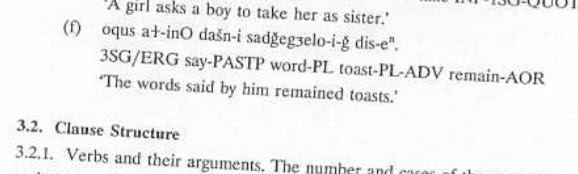
I'm reading Holisky & Gagua (1994), a grammar sketch of Batsbi. I just came across this sentence, "the words said by him remained toast". I like it, a lot. I take it that despite some sort of condition or expectation, the words he said remained to best be described as speeches or hot white bread. Like some sort of uncle at a wedding who never stops talking once he's got the space. There is no more context, so all we can do is speculate. Batsbi [bbl, bats1242] is spoken at the dot on this map below and transitivising affixes, inclusive pronouns and aorist. References Holisky, Dee Ann and Rusudan Gagua. 1994. Tsova-Tush (Batsbi). In Rieks Smeets (ed.), North East Caucasian Languages Part 2, 147-212. Delmar, New York: Caravan Books.

Smelling underarms in Apali

Image
We've had a new submission for Goodies from Grammar Reading - a series of blog posts with interesting, fun or in other ways noteworthy utterances found while reading linguistic description ( blogger posts here , old posts on tumblr here ). This one was noted by Siva Kalyan during Don Daniels' talk at the annual meeting of the Australian Linguistic Society (ALS 2015 in Western Sydney University). The example is taken from a collection of texts in Apalɨ by Martha Wade (Wade n.d.) and serves to illustrate the way this language encodes imperatives. The codes for this language are:  ena and  apal1256 . Original text : Vac-ɨna huji hisi sɨmɨl-ɨlɨŋ  u-avɨ-la-lɨ. Glossing : move.aside- 2sg.ds  underarm rotten smell- 1sg.imp  say- pl-hab-3 Translation: ‘ “Move aside and let me smell your underarm,” they say.’                  As utterances out of context goes, this...

Goodies from grammar reading returns - also: wallabies!

Image
I've noticed that there are way too few posts with Goodies from Grammar reading on this blog nowadays. When we posted only on tumblr, that tag was quite common , but since we've moved to blogger, we've only got one post tagged (goodiefromgrammar-tag ). Let's do something about that, after all we are humans who read grammars! For newcomers: we're interested in systematic cross-linguistic comparison (aka linguistic typology). To get at some of the information needed for that kind of research, one needs to consult already existing descriptions of language, preferably grammars. Of the 7000+ languages in the world, more than 4000 have at least a grammar sketch or even a longer grammar. There's tons to read. We're humans who read grammars because one could also have computers reading grammars or get similar information from comparing parallel texts.  We're less interested in large languages like Swahili, Hindi, Spanish, Punjabi Arabic and Russian and mo...

Comedy skit in language description! Talking body parts!

Image
Sorry we've haven't been posting for a while. Apologies offered, sent of into the blackness that is broadcasting into the internets - with hopes of acceptance and forgiveness. Also, hello to new followers on twitter, tumblr, blog and the book of faces!! If you would like to ask us something, comment or just share whatever, don't hesitate to contact us . This time I've got at goodie from grammar reading for ya! It's an excerpt from a corpus of Samoan, a language spoken on the pacific islands of Samoa. The excerpt is from this PhD dissertation: Mayer, John. F. (2001) Code-switching in Samoan: T-style and K-style. University of Hawai'i. This is only the beginning, in this text the different actors play different body parts and they all complain at a government of the body meeting about 'stomach' (he smells, he makes noises, because of him the gums have to chew and she doesn't like that etc etc). Many motion for the removal of the stomach, ...