Posts

Looking for a very interesting book...

Image
Familiar chain of events for many researchers, especially those dealing in fields where one needs to cite a lot of previous literature (like linguistics). Finds book in the local university library that looks extremely useful and interesting Gets very excited! Books! New knowledge! Tries to borrow it Cannot Sees the return date and notices that it's overdue Gets a vague feeling that the date looks familiar Tries to track down who has the book Realises that it's oneself Remembers that this is not the first time this has happened There's a last stage too that at least applies to me Realises that while it's necessary and good to read previous literature, there is such a thing as too much and when you just borrow books that looks useful but actually don't read 'em then it's better to spend that time with your own data and ideas..

Why and why not?

Image
As you probably noticed, several of the research projects I listed yesterday deal with the fundamental question of the driving forces of linguistic diversity and disparity. This all reminded me of one of my favourite Hjelmslev-quotes that we've posted befor e, but that always can do with some repetition. [the aim of linguistic typology/theory] must be to show which structures are possible, in general, and why it is just those structures, and not others, that are possible A famous quote that tells us a lot about the field of linguistics, or at least the aims of certain parts of the field. Form Hjelmslev, Louis (1970[1963]) Language. An introduction. Madison: The University of wisconsin press [translation by Francis. J Whitfield of Hjelmslev (1963) Sproget. En introduktion. Copenhagen: Berlingske Forlag,(page 96) Louis Hjelmslev (1899-1965)

Soon-to-come research in linguistics

Image
It's very hard for an outsider to get a grasp on what's currently going on in linguistics, so I assembled here a few quotes for you from different research proposals and descriptions that have come during this year. This is not by any means a complete overview, just a few personal favorites. This should give you a better view of what research proposals look like, and a few of the current topics in linguistics. Do follow the links to learn more. The spans of these projects are between 4-7 years and most often have just started or will very soon start. As you can probably tell there is considerable overlap in several cases. This might be a very good glimpse into studies that we should see published in a few years. If you are considering studying in linguistics or pursuing a career in any other science of the humanities, having a look at calls, proposals and research aims of institutes, departments and centers are a very good idea. You might also want to consider signing up f...

"Fact-finding, not theorising, is what is wanted at this present juncture."

Mark Dingemanse recently brought this quote to our attention at his blog, the Ideophone  There is an urgent need for the comparative study, over as much of the world as possible, of the full range of paralinguistic phenomena — the kind of thing for which the linguistic field-worker is best fitted. Fact-finding, not theorising, is what is wanted at this present juncture.  Abercrombie, David. 1968. “Paralanguage.” International Journal of Language & Communication Disorders 3 (1): 55–59. doi:10.3109/13682826809011441 http://ideophone.org/abercrombie-on-paralanguage/ Excellent, couldn't agree more.

tumblr linguistics at the Linguistic Society of America-meeting!

Image
Hurray! Gretchen McCulloch , of McGill University and All Things Linguistics, is gonna be talking about linguistics on tumblr in a panel at the meeting of the Linguistic Society of America! Read more about it in her post here and in the official abstracts of the panel !

Workshop on linguistic databases

Image
This week in Nijmegen there was a workshop on cross-linguistic databases, organized by Harald Hammarström and Guillaume Ségerer.  Here are some random highlights and thoughts.  One important application is in testing hypotheses about language history.  There were talks on  RefLex for reconstructing lexicons of languages in Africa; SAILS for inferring linguistic areas in South America; and the history of Austronesian languages using the World Phonotactics Database . PHOIBLE , a database of 2160 phonemes/segments and which languages they are found in, has new materials available for download at the PHOIBLE Github such as the decomposition of each phoneme into phonological features.  You can search not just for languages with a certain phoneme, but for languages with phonemes defined by a certain set of features (e.g. all types of 't', or all fricatives). Some semantic databases were shown, including a beautiful visualization tool for showing common...

Human beings in our planetary society, our pale blue dot

Image
I enjoy scientific literature that talks about "humans" and our "planet". Here are some examples of this from linguistics. Human beings on our planet have, past and present, used a number of languages.  From the description of the BCP 47 codes. The Linguasphere Register of the World's Languages and Speech communities is the first classified inventory of the linguasphere , the communicational environment which humankind has progressively extended around the globe since the invention of speech.  (..) The intended audience comprises not only specialists in linguistics and specific languages, but above all a general readership concerned with the future of humankind, and with the need to reflect on a collective global environment and a shared cultural heritage. (..) Every person is intimately involved with one or more languages as a central factor of their life on this "planet of speech", and everyone is already – or soon will be - di...

Scandal: linguistics used horribly wrong in evaluation of immigrant/fugitive's stories

Image
Ethnologue editor Paul Lewis just wrote a very important blog post abut how to not use Ethnologue . Ethnologue is a catalog of the worlds languages with information on their genealogical relationship, number of speakers and some more demographic information. It's by SIL, the holders of the ISO-codes for language name s. Ethnologue is usually the first go-to source for anyone wanting to know number of speakers and family relations and ISO-codes, both linguists and non-linguists use it frequently. (You can also use Glottolog , which often has better genealogical trees, division of languages and A LOT of bibliographical data, but no info on number of speakers or all countries the language is spoken in.) Basically, governments have been misusing Ethnologue by using it as the ultimate source on who speaks what where.  In one case, the U.S. Immigration and Naturalization Service used the fact that the Ethnologue had no listing for a language by the name a defendant was us...

South America in Linguistic Typology

Image
Ergativity on tumblr just  made a post with this quote: “ [South America] has been underrepresented in typological surveys and in the typological literature generally, and knowledge of the different kinds of typological features and their distribution in the world is significantly limited by this absence. ” —  Campbell Lyle & Grondona Verónica (Eds.). 2012.  The Indigenous Languages of South America: A Comprehensive Guide ,vol. 2. p.259 (via  ergativity ) This is true and not ideal. In light of that, I'd just like to again bring up the free online linguistics database SAILS (South American Indigenous Language Structures) . You can find out a lot of information about many languages of SA there. You find a helpful post about it here . You can also have a look at SAPhon, South Ameircan Phonological Inventory Database . There are over 380 million people living in South America and 458 living languages. There are grammars or grammar sketches of at...

What linguistic terminology bothers you?

Image
So, we've talked before on this blog about linguistic terminology. It's well-known that linguistics has a lot of terms, many of them used differently in different contexts or restarted un unexpected ways. Right now I'd like you suggestions for linguistic terminology that stands out. I'd like to know terminology that you find to be restricted in an unusual way to a certain group of linguists or language family unusually polysemic restricted in time in som way (archaic or very new for example) If you have any suggestions, feel free to submit them h ere ! All you need to do is follow that link and edit the spreadsheet (anyone can edit, you don't even need a Google-ID), or leave a comment here on this blog post or tell us here . Don't worry about really clever or super new suggestions, all suggestions are good suggestions just lay them on me :)! I also recommend reading   this text I wrote here about linguistic terminology and the dangers of sta...

Get the best colors for your map!

Image
If you are making maps, you need this new thing I've just been introduced to: Color brewer! Hurray! It's a simply site that helps you select colors for your maps that are maximally contrastive and informative, but also safe for color blind people, printing etc. It might not solve problems with projectors (you know what I'm talking about), not sure about that yet. Anyway, it's a great thing and I am very happy about it!

Linguists are humans too

Image
Humans like to form groups, and linguists, and academics in general, are human too (despite popular beliefs that we're all lizards and/or AI ). Within these groups there are certain shared conventions and expected shared knowledge and assumptions. Groups are established both by shared conventions, culture etc, but they are also a product of the exclusion (intentional or not, explicit or implicit) of others. The rules that govern whether or not a statement is a viable member of a language is called grammar, it can vary with each group you are a part of and even over time and specific context within that group. Sometimes the term "grammar" is used more broadly also outside of the study of language and is also applied to any set of rules that govern whether something is a member of a system or not, such as the grammar of Chinese ice-ray latices (see Stouffs & Wieringa 2006). FYI, this is a an ice-ray latice (image taken from here ) ---> (This perspective lead...

Free Online Linguistics Databases!

Image
So, linguistic typology (the method/field of systematic cross-linguistic comparison) is sorta a combination of this and this  In order to share this joy/pain with the world we have a series of post on Free Online Linguists Databases where we try and recommend a few, provide some background to them and some advice on how to use them. We made a list of the ones done so far, and the ones we'd like to write about in the future, looki-looki! If you need help with linguistic terminology, we've compiled a list of places you can turn and problems you might want to be aware of. Do tell us if we're missing something or if there's a term you don't understand :)!  Happy typologizing!  And always remember: read their definitions carefully before questioning the coding of a feature in a specific language, if problem still remains or definition is non-existent: then email the editors.

WALS Sunburst Explorer!

Image
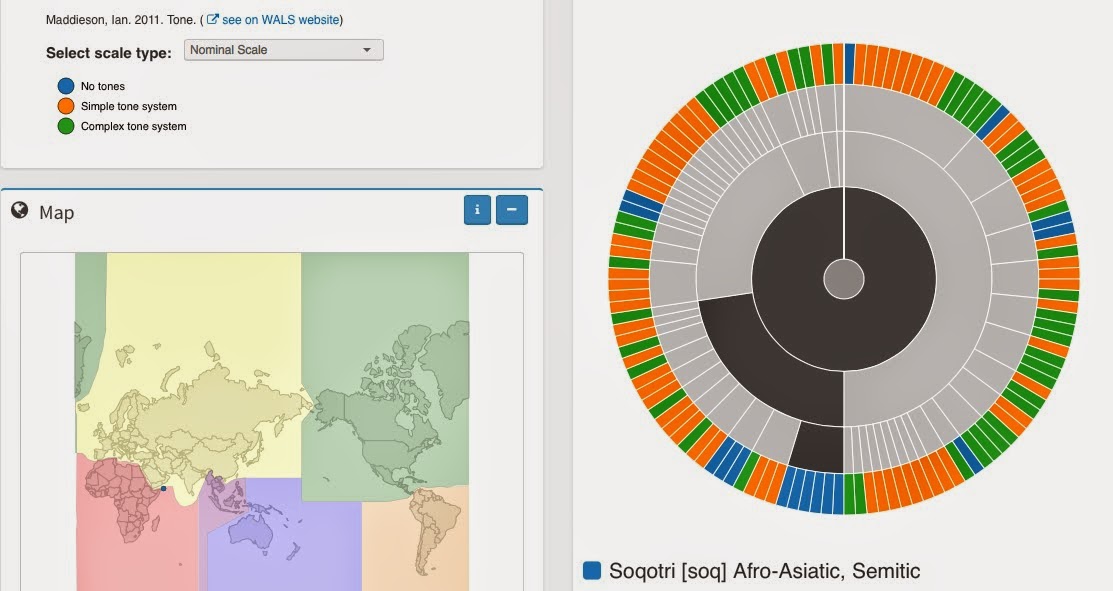
There's a new kind of tool that lets you explore the data from the World Atlas of Language Structures (massive typological database): WALS Sunburst Explorer ! This new tool let's you investigate the WALS data and correlations between typological features and geographical areas and/or genealogical groupings in an easy way. It's very user-friendly, just go there and click around and you'll understand. You can manipulate the map and the "wheel" (the "sunburst") by clicking on segments. It's based on the  classical genealogical classification of WALS  (i.e. not identical to  Ethnologue  or  Glottolog , mind you) and more or less classical divisions of the world into countries and macro areas (Africa, South America, North America, Oceania, Eurasia and South East Asia). You can also define your own areas by selecting an area on the map. The center of the wheel when you start is "all", the first level outside is macro areas, the...

Inventories of the speech sounds of 1, 627 languages now online!

Image
A new update of P HOIBLE (Phonetics Information Base and Lexicon) is up!! It now features  1, 627  languages! And it's freely available online with a user-friendly interface! A phonetic inventory is a description of the speech sounds in a language that are meaningful, i.e. if one changes on into the other it makes a change in meaning. [l] (< l ow>) and [ɻ] (< r ow>) are for example  both phonemes of English, but not in Korean or Mandarin. We're gonna tell you lots more about it under the tag FreeOnlineLinguisticsDatabases, but for now just enjoy that there's a new version up with lots more languages and other handy changes to the site!  Hurrah!

Linguistic relativism short

Image
Today I'd like to share with you a short excerpt from an abstract of a talk by Asifa Majid that I just found very well put. Some believe that language is a direct window onto concepts: Having a word ‘‘bird’’, ‘‘table’’ or ‘‘sour’’ presupposes the corresponding underlying concept, BIRD, TABLE, SOUR. Others disagree. Words are thought to be uninformative, or worse, misleading about our underlying conceptual representations; after all, our mental worlds are full of ideas that we struggle to express in language. How could this be so, argue sceptics, if language were a direct window on our inner life?   from Majid, A. (2012). Taste in twenty cultures [Abstract]. Abstracts from the XXIth Congress of European Chemoreception Research Organization, ECRO-2011. Publ. in Chemical Senses, 37(3), A10. (free PDF here)  Also, I'd like to share an old sketch of mine where I tried to illustrate langue and parole in conversation. Please don't take it as underlying concepts = ...

More Open Access Publishing of Linguistic Descriptions!!

Image
There's a new Open Access Publishing initiative in town: Endangered Languages Publishing ! There are now three (Platinum) Open Access publishing houses in linguistics: Language Science Press , Language Documentation & Conservation and Endangered Languages Publishing . There are others, the old houses are trying to keep up, but these three adopt a very radical version of Open Access: publications are free for both authors and readers ("Platinum OA"). Endangered languages publishing (EL publishing for short) was just recently founded by Peter Austin, David Nathan and Julia Sallabank​​. Their website has already had over 1900 visitors and among other things contains the latest volume of Language Documentation and Description (LDD 12 -- a special issue on documentation and archiving), an app dealing with Khoi-san languages, and the complete back catalog of LDD volumes 1 to 11.​ David Nathan wrote a very good post on the PARADISEC blog about the first month of ...

If political borders were redrawn to match "protection of speakers of major languages"

Image
Apparently Putin has been arguing that one of the motives of going into Crimea is that Russia owes protection of Russian speakers everywhere. As you probably can tell this is a very strange argument and if it was true the world would look very different. The Economist decided to follow up on this and based on the CIA Factbook and the Ethnologue they produced the map you see below. They also added some fun commentary, go read!     © The Economist Newspaper Limited 2014  Besides being a fun joke on Putin's silly argument, this map is a very educational illustration of colonialism and in particular the so called " Scramble for Africa" . If you missed that part of world history in school, do take a long good look at this map up above by going to the original article and zooming in . The blog of the Ethnologue also joined in and added some much needed reflections on the state of diversity in the world today, it's a definite must-read for all interested ...

What if there was a place where we didn't review results when approving publications?

Image
I'm day dreaming about there existing a journal/book series of academic publications that encouraged improvements and innovation in methodology and data collection by letting reviewers review everything but the results when approving articles. This has actually already been done once (thanks Lilla for the tip): These proposals will be reviewed for their importance and soundness. Once provisionally accepted, if authors complete the study as proposed, the results will be published without regard to the outcome. Academic scholars publish their results as articles in journals, as chapters in edited volumes, as monographs, as conference oral presentations and sometimes also as in conference proceedings etc. Practically all of the time the work get reviewed before hand by anonymous reviewers, often working for free, and they approve or reject  - most often with the condition that certain revisions are made. Many academic publications have the structure of:  introduc...

Comedy skit in language description! Talking body parts!

Image
Sorry we've haven't been posting for a while. Apologies offered, sent of into the blackness that is broadcasting into the internets - with hopes of acceptance and forgiveness. Also, hello to new followers on twitter, tumblr, blog and the book of faces!! If you would like to ask us something, comment or just share whatever, don't hesitate to contact us . This time I've got at goodie from grammar reading for ya! It's an excerpt from a corpus of Samoan, a language spoken on the pacific islands of Samoa. The excerpt is from this PhD dissertation: Mayer, John. F. (2001) Code-switching in Samoan: T-style and K-style. University of Hawai'i. This is only the beginning, in this text the different actors play different body parts and they all complain at a government of the body meeting about 'stomach' (he smells, he makes noises, because of him the gums have to chew and she doesn't like that etc etc). Many motion for the removal of the stomach, ...