Posts

Showing posts with the label Annemarie

Online resources on linguistic typology and beyond

Image
Many Humans Who Read Grammars are also teachers of some kind, myself included. With the world-wide outbreak of COVID-19, most of this teaching is forced to be no longer in a classroom setting, but rather in a remote fashion. This comes with one benefit: if someone can tell it better than you, and a video of it happens to be on youtube, get your students to watch that lecture! So, please find some resources on linguistic typology & co below. First up is a short list of youtube videos on linguistic typology and some related topics. There is an entire MA course called 'Language Typology' from the Virtual Linguistic Campus (Uni Marburg). Here is a link  to the  Virtual Linguistic Campus , featuring many more lecture series on topics in linguistics. The same for this course here , a full course from the NPTEL-NOC IITM channel that contains a lot of courses, also on linguistics. A  set of mini-lessons in linguistic typology by  Isabel Cooke McKay , including ...

A decade of state-of-the-art quantitative methods in linguistic typology

Image
Some turning points in linguistic typology are easily recognised, such as the ground-breaking work by Joseph Greenberg on implicational universals entitled "Some universals of grammar with particular reference to the order of meaningful elements" (Greenberg 1963). Other turning points are less well-defined, less commonly associated with a single paper, or a specific typologist, team, or place. But there was definitely something in the water during, let's say, a period  centred  around 2010  –  a change that we could call the quantitative turn in linguistic typology.  Linguistic typologists have long recognised that the languages of the world are related in various ways, most importantly, in nested arrays of hierarchical descent (genealogy) as well as in so-called Sprachbunds or linguistic areas (geography). For a long time, i.e. work reaching from Bell (1978) all the way to Bakker (2010), these interdependencies have been viewed as something of a nuisance, so...

Language family maps

Image
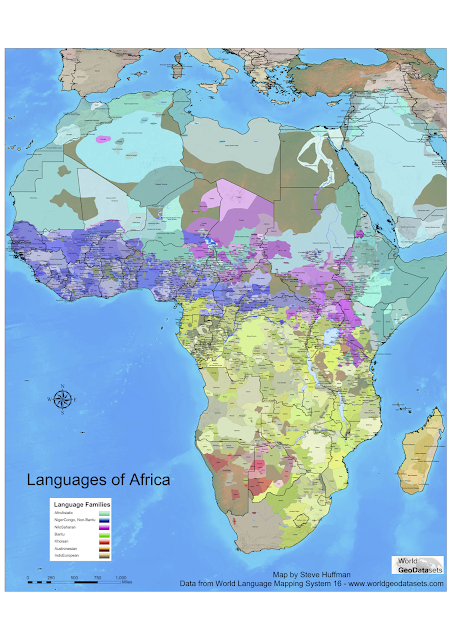
Last week, I assigned Bernhard Comrie's (2017) chapter 'The Languages of the World' (from The Handbook of Linguistics, 2017) to a class. It's a basic overview of the world's language families, which is what I wanted them to read, but for one thing: there are no maps in it. I overcompensated in class by presenting a 30-item list of maps, because some things are just so much easier to understand using visual representations. I decided to post some of the best ones I could find here, for future reference and in order to invite you to post better ones in the comments. This blog has featured posts on maps before, by  Hedvig on how to best represent linguistic diversity on maps and by  Matt on new approaches to ethnographies-linguistic maps . It's clear that the kind of maps that are typically used to depict the spatial distribution of languages of a single language family are fraught with difficulties. Typically they deal with multilingualism very poorly, the data...

ALT2019 conference report

Image
Two weeks ago, the 13th Conference of the Association for Linguistic Typology (ALT) took place in Pavia, Italy. As the name says, this is the main gathering for members of the Association for Linguistic Typology , and it's on a different continent every two years. It just happened to be in Europe as I was ready to go conferencing again (now dragging two kids in tow) so that was lucky. I like ALT a lot because I can go to basically any talk and find myself interested in it. There are hardly any talks or posters where I am disappointed because it isn't really my cup of tea - it's all typology so everything is my cup of tea :)! It is where the humans who read grammars gather. This year, ALT was paired with a summer school on 'Language universals and language diversity in an evolutionary perspective', which I would have loved to attend (but, kids). For the first time in history (as far as we could find), ALT offered child care. About 5 attendees made use of this (...

Brust, breast, borst: an encounter with r-metathesis

Image
Two months ago I gave birth to our second daughter. In order to prepare for this joyous event, I prepared by trying to get some of the local (German) vocabulary on labour & babies in my head. One of the words I had some trouble with was Brust 'breast'. Basically, my German reading is pretty decent, but speaking and writing are another matter, I just don't have enough vocabulary at the ready, hence my quest. Until now I could get away with blaming my high school education, where I suffered from a then new policy to split up second language education in a compulsory reading module and an optional speaking & writing module that I did not take. Having lived in Germany for over two years now, it's getting rather embarrassing though. Anyway, back to Brust . The reason I found it confusing is that compared to my native Dutch, the r is in the wrong place: in Dutch it's borst 'breast'. Hmm. English breast has the r in the same place as German though. T...

A week of Bantu grammar reading: The good, the bad, and the ugly

Image
In my week of grammar reading, there were some truly good, truly bad, and truly ugly aspects. It was entirely devoted to Bantu , as it has been for some time, because of a project on Bantu gender systems I am doing together with Francesca Di Garbo of Stockholm University. Bantu languages are best known for their complex morphology, both involving the noun ( gender ) and the verb (Tense-Mood-Aspect). The noun typically is classified in up to around 12 different genders, signified by prefixes that attach to the noun root, and prefixes that mark agreement with the noun throughout the clause. To start with the good, below is an overview of nominal prefixes in Ding (diz), spoken in the Democratic Republic of Congo. The Roman numerals in the first column signify each gender, the two subsequent columns relate the singular and plural prefixes used for nouns, including different forms, and the final column gives examples of the type of noun found in each gender.  Merten...