Posts

Showing posts with the label image

Language family maps
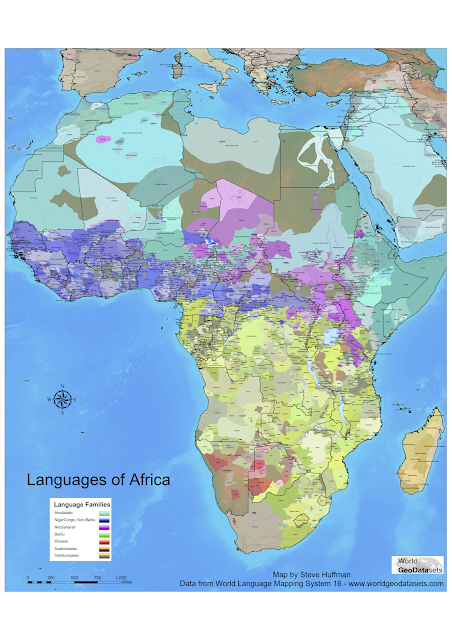
Image
Last week, I assigned Bernhard Comrie's (2017) chapter 'The Languages of the World' (from The Handbook of Linguistics, 2017) to a class. It's a basic overview of the world's language families, which is what I wanted them to read, but for one thing: there are no maps in it. I overcompensated in class by presenting a 30-item list of maps, because some things are just so much easier to understand using visual representations. I decided to post some of the best ones I could find here, for future reference and in order to invite you to post better ones in the comments. This blog has featured posts on maps before, by  Hedvig on how to best represent linguistic diversity on maps and by  Matt on new approaches to ethnographies-linguistic maps . It's clear that the kind of maps that are typically used to depict the spatial distribution of languages of a single language family are fraught with difficulties. Typically they deal with multilingualism very poorly, the data...

Illustrating language history

Image
This image illustrates the situation that any researchers trying to understand and reconstruct the past of a current situation with related  tokens  faces - be it in biology, linguistics or another field. Only a sliver, a slice of time is available to us and from that we try to go back and reconstruct relationships. What's nice about this picture is the branches reaching across (C), thus appearing close to others (B) in that slice of time, but actually it's genealogically related to another further away token (F). It does not really illustrate horizontal influence, i.e languages (in our case) becoming similar due to contact - unless you consider the closeness across the x & z-axis' , like with C & B. Also, notice the branches that don't make it all the way up, the extinct species/languages/etc. I saw this image for the first time in a presentation by Fiona Jordan and liked it a lot. It's originally from Strickberger (1990), who adapted the...