Posts

Showing posts with the label fieldwork

My ELAN workflow for segmenting and transcription
Image
Hello everyone, Hedvig here. I'm currently writing up my PhD thesis, hence the lack of writing here. Hopefully I'll be able to pick it up after submission, there's a lot of drafts lying on blogger waiting for completion. If you really, really miss me in particular, you could listen to my ramble at Talk the Talk - a weekly show about linguistics. Now that the shameless plug and excuses are done with, let's get down and talk about: THE TRANSCRIPTION CHALLENGE! In this blog post, I will focus on a part of this challenge¹ - the workflow for segmenting and transcribing  audio material. This is a rough guide, if it turns out people appreciate something like this I'll re-write it more thoroughly. This is a bit sloppily written in places, but trust me - if I do this "properly" right now I will lose days of work time that I should be spending on my thesis... so, I'll only do it if people really want it - and I might wait a while until I do. Sor...

ELAN: making tier(s) out of search results

Image
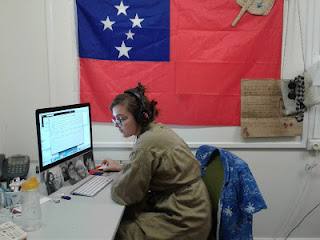
Hedvig in her office in Canberra figuring this out and writing this guide. Here is another guide for how to do something practical in ELAN. Previously, we relayed Eri Kashima's guide for sensible auto-segmentation with PRAAT and ELAN (time saver!). (For all posts about fieldwork on this blog, see this tag. ) This time: how to take your search results and make the matching annotations into new separate tier(s). This is useful if you for example want to cycle through only the annotations that match a certain search query in transcription mode. This post has a longer guide, and a short guide at the end. You can also use this guide if you want to compare several different transcriptions with each other, for example older and newer versions or if you are collaborating with different people. In that case, start from step (4). For those who don't do a lot of transcription : ELAN ( E UDICO  L inguistic  An notator) is a program from TLA at MPI-Nijmegen. This program allow...

Time-saving magic for linguist fieldworkers: automatic segmenting with PRAAT and ELAN

Image
A typical recording situation from my own fieldwork.  Melenesa (my research assistant) and Ta'alolo (one of my informants) in Neiafu-Tai village on Savai'i, in Samoa. Keeping on the theme of linguistic fieldwork (see Jeremy's previous post about his fieldwork experiences here here and Jesse's post about measuring nasality with earbuds here) , I've also got something for you! Two colleagues of mine in the Wellsprings of Linguistic Diversity project, Eri Kashima and Mark Ellison, have figured out a neat way of saving time on segmenting up sound files for transcription. Linguistic fieldwork is so much more than just the time spent in the field site, when you come home there's a lot of work that needs to be done with annotating your files, segmenting them up and in different other ways preparing them for the analysis you want to do. Yours truly, handling transcription files in ELAN in her office in Coombs, Canberra. One thing that takes a lot of time, a...

Nasality in a world of orality

Image
Nasal leakage: It's a real condition affecting field linguists around the world. Does the language you work on have nasal sounds? Rhetorical question! Of course, it does! Even if nasality is a non-contrastive feature of a language, air finds its way out through the schnoz one way or another during language production [ WALS; nasality ] . There's no stopping the all-knowing nose . While the burning question on everyone's mind is, if the magnificent bone structure of Worf's forehead is connected to his nasal cavity, what kind of resonance can we expect, there's a more pressing issue here (yes, really). A survey of 372[1] grammars listed on the Grammar Watch List of the Association of Linguistic Typology revealed that empirical bases for claims regarding nasality are virtually non-existent. In cases were nasality was described, they were solely based on impressionistic observations. The reasons for this in the past had often been just; equipment for ...

Shit, There Are Dogs: Fieldwork on Austroasiatic Languages of Southwest China

Image
This is an account of my linguistic field trips to Xishuangbanna in southwest China in 2015-2016.  I visited a total of fourteen villages, plotted on the map below, and recorded dialects of Palaungic languages in the Austroasiatic family.  I describe both my experiences doing fieldwork and some of the amazing linguistic variation in this region. I did this study as a paper for my PhD thesis at the Max Planck Institute for Psycholinguistics, where I was lucky to meet friends and colleagues who I learnt about fieldwork from, such as  Luis Miguel Berscia  in Peru (who is described in this splendid  article  in the New Yorker),  Simeon Floyd  in Ecuador,  Lila San Roque  in New Guinea,  Mark Dingemanse  in Ghana,  Nick Enfield  in Laos, and  Ewelina Wnuk  in Thailand, to name just a few. Linguistic fieldworkers like these bring to my mind an image of braving malaria and take boats for days to remote ...