Posts

Showing posts with the label freeonlinelinguisticdatabases

Public service announcement: list of databases and more

Image
Public service announcement: there are website that keep a well-curated list of things that are useful to linguistics researchers and students, including the following: Language Goldmine - catalogue of cross-linguistic databases Linguistic terminology (us here at HWRG) Platinum Open Access publishing in linguistics More Open Access Linguistics  (us here at HWRG) Online tutorials for linguistic tools (ELAN, R etc)  (also HWRG) free online PDFs of publicly available grammars  (ALT) Language universals Weird things in langauge (Rara & Rarissima) CALS (Conlang WALS) It would appear that some don't know about these lists, so now you know/are reminded :). Lists are good, and instead of reinventing them you can look through these and add to them. For more hopefully useful stuff like this, go here.
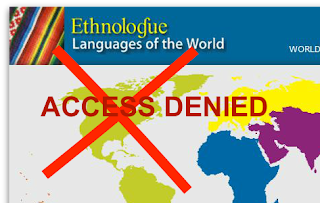

Ethnologue more restricted

Image
In April this year, Ethnologue changed access restrictions to their website again. Now, non-paying users from high income countries can only access 1 page per month before they are banned, previously it was 7. In light of this change, we will go through some basics regarding the paywall again (old post here) and where you can go instead. Finally, I list some questions should any SIL International/Ethnologue staff see this post. Basics on the pay-wall We haven't received much detailed information on this change, but if it's the same as last time it means that users with IP-addresses in countries that are classified by the world bank as "high-income" will be restricted.   Cloudflare would appear to be the service provider managing this for Ethnologue.  Previously, we've learned that only 5% of users look at more than 7 pages per month.  We don't know how many go to more than 1 page (probably a lot more though!). SIL International also maintains the IS...

Feeling bummed about the Ethnologue pay-wall? Cheer yourself up with these freely accessible resources

Image
Lists, lists, lists & posts  - we've  got lists and posts to make you happy!! The Ethnologue might be instituting restrictions, but many other parts of linguistics - especially documentation and descriptive, is getting more and more open! list of open access venues in linguistics post explaining open access and varieties of it list of cross-linguistic databases  by Bodo Winter list of helpful blog posts on freely accessibly cross-linguistic databases posts tagged "free PDF", because - you guessed it - they contain links to interesting publicly available research  posts tagged "Open Access", because obvious a post on the newly started Open Access publishing house, Endangered Languages Publishing Also; why not indulge yourself in some of the other resources SIL has produced and that are accessible freely? Such as: Online Dictionaries of the World - Webonary ,  Linguistics Glossaries ( English only  &  French...

The World Atlas of Universal Grammar

Image
The World Atlas of Universal Grammar is an ongoing project documenting features of languages, by a team of more than eight authors.   Each feature is a structural property that describes one aspect of cross-linguistic homogeneity.   A feature has between 0 and 87178291200 values, shown by different colours on the maps.  Here is a sample of the features listed by author. Steven Pinker Does the language reverse the order of words in a sentence to form a question? Yes       No Does the language employ musical melodies for words and major/minor keys for polarity? Yes       No Is the language made up only of two-word utterances, with larger compositional meanings deduced from pragmatics? Yes       No Is it the ‘language’ of bee dance? Yes       No Does the language specify grammatical relations not in terms of agent and patient, but in term...

If only descriptions listed all allophones of each phoneme..

Image
I'm at a workshop and made a little doodle that I thought y'all might like, it expresses my inner desirers if I was ever to move from grammatical typology to phonological typology.  Phonology is the study of which sounds in languages are used to distinguish meaning, phonemes are the sounds that make a difference in meaning. Phonemes don't have sounds, they are multiple sounds with distinctive boundaries to other phonemes - other sets of sounds. A phone is the individual instance of sound. Allophones are all the phones that together make up a phoneme. Phoneme typically have one phone that is the most frequent and is used as shorthand for the entire set. For example, in Swedish [s] and [z] are allophones of the same phoneme, but we usually represent this set by [s] because it is the most common one. However, when we compare to for example English where [s] and [z] are very different animals, in fact so different that a change in them creates a change in meaning - i...