Posts

Showing posts with the label listentotheworldslanguages

Listen to the world's languages pt 4!

Image
There's a lot of website around where you can literally listen to the diversity of the world's spoken languages, we've covered a few of them before under the tag Listen To The World's Languages . Since we last made a post, we've found some more sites for you to enjoy. Just to reiterate here's a list of the sites we already mentioned before: Language Landscape  (global coverage, crowdsourced, you can add) Phonemica (mainly languages of China) Sound Comparisons ( created for historical linguistics purposes) The Wide Language Index   (the audio samples of the Great Language Game) The language Familiarization Game (from Maryland's "Langscape") Algonquian Language atlas  (Cree, Ojibwe etc) Now, to new additions in this category. We've got six for you this time, all quite spectacular!  *** Radio garden Website . Article from The Verge about it. Radio Garden  is a Transnational Radio Knowledge Platform traveling online e...
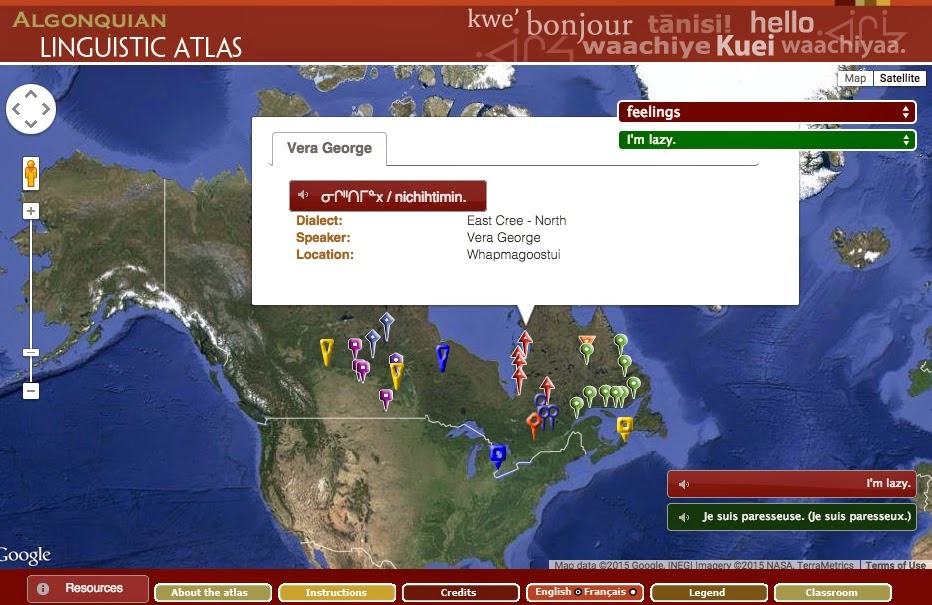
Listen to the world's languages - part 3: Algonquian!

Image
We've posted here before about sites online where you can listen to audio samples from the worlds languages, see part 1 and part 2  (or check the tag listentotheworldslanguages ). Go have a look, there are plenty of exciting sites where you can have a listen to the diversity of our planet! This time: The Algonquian Linguistic Atlas! On the site of the Algonquian Linguistic Atlas you can listen to audio samples from different categories (greetings, feelings, at the store, etc) from many different algonquian languages. The idea is similar to the Sound Comparisons site that we covered before where you can listen to European languages. What is so great about this site is that you can pick a word or phrase, say "I'm Lazy", and listen to how it sounds in the different languages and see how they are similar and different. You can see the chains of contact and shared genealogy and what changes and what is more stable. Each audio sample is accompanied with a tran...

Listen to the world's languages! 2: Sinitic and other languages on Phonemica

Image
Following on from the preceding post on listening to the languages of the world by navigating audio samples on maps, here I will introduce Phonemica 乡音苑/ 鄉音苑, a website with user-contributed audio files of Sinitic (and some other nearby) languages, mapped by pins that are (supposedly) colour coded by linguistic affiliations. Even if you are not into Sinitic languages, it is fun to listen to, and familiarise yourself with, the various Sinitic languages. (You know, just in case, e.g., the next pub quiz asks you to distinguish the Cantonese vs. Mandarin vs. Taiwanese Mandarin versions of 'Let It Go'.) Version A Version B Version C (And just for fun, unofficial versions of 'Let It Go' in Taiwanese , Shanghainese , and 26 Sinitic lects .) The level of diversity amongst the Sinitic languages is similar to that amongst the Romance languages. At around the same time that Vulgar Latin was spread around by Roman soldiers, Late Archaic/ Early Medieval Chinese...

Listen and watch the world's languages!

Image
There is a site called Language Landscape where you can listen and see languages of the world by navigating audio samples on a map. They're currently offering 357 samples, both audio and video (because remember: sign language!!), go check it out and contribute your own! It's super awesome. You remember sometime ago when Jeremy Collins wrote a post here in connection with a workshop on cross-lingusitic databases and wrote that he  would like to see data points tied to specific speakers and geographical coordinates, as one possible solution. Well, guess what the Language Landscape does? Exactly that! I've just come back from SOAS in London where I met a certain Samantha Goodchild that works on Language Landscape and told me about the site . Such cool stuff, y'all go contribute, listen and watch now! While you're at it you should also go to Paul Heggarty and Colin Renfrew's site Sound Comparisions where you can hear cognate sets from lots of languages....