Posts

Showing posts with the label grammar

International Women's Day - Joan Bresnan

Image
Today is International Women's Day. Here at HWRG we're celebrating it by highlighting an important female linguist. Today we're honouring Joan Bresnan, who together with Ronald Kaplan, founded the theoretical formal grammatical framework Lexical Functional Grammar (LFG) and has written numerous influential papers. Trading card of Bresnan by Parkvall . She is still active as a Professor Emerita in Humanities at Stanford University and also a Senior Researcher ( Spoken Syntax Lab ) at Stanford's  Center for the Study of Language and Information.  Her research and LFG is much informed by a wide knowledge of linguistic diversity, in particular of Australian and Bantu languages. LFG is still a popular framework in linguistics and continues to develop.  Here is a quote by Bresnan that illustrates her ideas and experience of formal linguistics very well: I began to realize that we theoretical linguists had no privileged way of distinguishing the possible formal...

Play fish communication game!

Image
PLAY FISH COMMUNICATION GAME! Some mates of mine are doing an experiment involving a very short online task where you learn fish songs. You need android or Firefox if you're on a desktop computer to play. Play it and spread the word! For other games advancing science, check the "games" tag.

Toasts in a grammar

Image
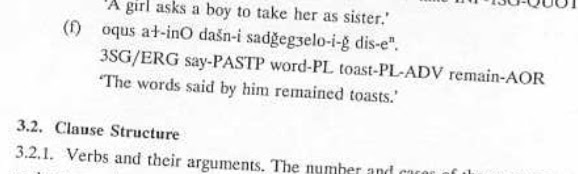
I'm reading Holisky & Gagua (1994), a grammar sketch of Batsbi. I just came across this sentence, "the words said by him remained toast". I like it, a lot. I take it that despite some sort of condition or expectation, the words he said remained to best be described as speeches or hot white bread. Like some sort of uncle at a wedding who never stops talking once he's got the space. There is no more context, so all we can do is speculate. Batsbi [bbl, bats1242] is spoken at the dot on this map below and transitivising affixes, inclusive pronouns and aorist. References Holisky, Dee Ann and Rusudan Gagua. 1994. Tsova-Tush (Batsbi). In Rieks Smeets (ed.), North East Caucasian Languages Part 2, 147-212. Delmar, New York: Caravan Books.

Glossing, how I miss you!

Image
I'm currently reading some older grammars that are written in a quite different style from most modern grammars. They're very ambitious, meticulous and good in many ways, but most crucial is the fact that they lack glossing. I miss glossing so! Glossing is a way for linguists to divide up utterances and translate more fine-grained units so that other linguists can have a better understanding of what's going on. When reading a grammar and trying to understand how the language works, glossing is immensely useful and practical. You as a reader might be interested in different things from the author, and glossing makes their analysis more transparent and makes more information available to the reader.  You can read more about it, and conventions for it, here. Let's make ourselves happier by looking at some of my favourite glossing ever, the texts of the project on Typology of Negation in the Ob-Ugric and Samoyedic language s. I'm not even kidding, looking at the...

Go play some language games!

Image
There are more and more exciting new tools cropping up for scientist to gather data, and in linguistics one new tool such is gaming! We just had a talk here at CoEDL at ANU from a researcher working on mutual intelligibility of closely related european languages - Charlotte Gooskens  - where they've been using games to investigate this question. Apropos that, I thought I'd let you all know about some games you can play that can further our understanding of language! Go play games, for science! Mutual understanding between closely related languages-game As a speaker of a major european language, how good are you at understanding your neighbours? Really... :)? Link to game. Link to science behind (don't look before playing!) LingQuest! How good are you at correctly identifying which language you're hearing? Test yourself on over 30 European languages and other languages from all over the world. Included are many languages currently under study in the DOBES-...

Generative and non-generative ideas of the current questions and aims of linguistics

Image
This is a blogpost about the way that different linguists see the great challenges and aims of linguistics, it's full of quotes that I hope will prove illustrative. The quotes are taken mainly from here   and here , you can also go there to read more. As usual, you're more than free to skim and scroll, there's quite a few quotes this time. On this blog we're interested in discussing  what the "Big Research Questions" in linguistics  are, and also we've been interested in getting past the functional-fenerative divide that often is very destructive.  Two of our readers even commented that the inflammatory "debates" of the Great War are "profoundly unattractive" and that they had left that part of linguistics intentionally because of it's unproductive nature. Here's Haspelmath describing the situation: It is not hard to see that linguists who work on linguistic diversity tend to fa ll into two very rough sociological g...

Smelling underarms in Apali

Image
We've had a new submission for Goodies from Grammar Reading - a series of blog posts with interesting, fun or in other ways noteworthy utterances found while reading linguistic description ( blogger posts here , old posts on tumblr here ). This one was noted by Siva Kalyan during Don Daniels' talk at the annual meeting of the Australian Linguistic Society (ALS 2015 in Western Sydney University). The example is taken from a collection of texts in Apalɨ by Martha Wade (Wade n.d.) and serves to illustrate the way this language encodes imperatives. The codes for this language are:  ena and  apal1256 . Original text : Vac-ɨna huji hisi sɨmɨl-ɨlɨŋ  u-avɨ-la-lɨ. Glossing : move.aside- 2sg.ds  underarm rotten smell- 1sg.imp  say- pl-hab-3 Translation: ‘ “Move aside and let me smell your underarm,” they say.’                  As utterances out of context goes, this...

Goodies from grammar reading returns - also: wallabies!

Image
I've noticed that there are way too few posts with Goodies from Grammar reading on this blog nowadays. When we posted only on tumblr, that tag was quite common , but since we've moved to blogger, we've only got one post tagged (goodiefromgrammar-tag ). Let's do something about that, after all we are humans who read grammars! For newcomers: we're interested in systematic cross-linguistic comparison (aka linguistic typology). To get at some of the information needed for that kind of research, one needs to consult already existing descriptions of language, preferably grammars. Of the 7000+ languages in the world, more than 4000 have at least a grammar sketch or even a longer grammar. There's tons to read. We're humans who read grammars because one could also have computers reading grammars or get similar information from comparing parallel texts.  We're less interested in large languages like Swahili, Hindi, Spanish, Punjabi Arabic and Russian and mo...